|
|
|
|
|
|
|
Newfound Harbor
Marine Institute
on Big Pine Key, FL
"Sea Camp"
|
|
Keys Trip Parent Meeting for
2007-08
|
|
Thursday, August 30
|
|
Chaperones
|
|
Sea Camp limits the number of parent chaperones we are allowed to bring -- probably 6 for this year
|
|
Trip Deposit
|
|
A $200 deposit (check made out to Hanes Middle School) is needed by Sept. 6th.
|
|
Payment Schedule for 2007 - 08
|
|
Deposit -- Thurs., Sept. 6
2nd Payment -- Oct. 4
3rd Payment -- Nov. 8
4th Payment -- Dec. 6
5th Payment -- April 26
|
|
Quick Questions
|
|
Q: Why is a trip to the Florida Keys & Everglades a better educational experience than a similar trip to the N.C. Outer Banks?
A: The Florida Keys offers an unusual clear-water tropical marine environment where students can snorkle to mangrove islands, coral reefs, sponge flats, and turtle grass communities. Newfound Harbor Marine Institute is an ideal base for students to explore these unusual marine habitats. In addition, the Institute offers SMALL GROUPS led by trained marine biologists and lab facilities with microscopes, specimen collections, and printed resources we would be unable to provide at the Outer Banks. The Everglades offers a unique ecosystem found nowhere else in the world. If global warming becomes a reality, it is likely that the Everglades, due to their low elevation, will disappear forever beneath the waters of the Gulf of Mexco
The North Carolina UNC - Wilmington marine biology program cannot handle large school groups. In addition they have no microscopes, no labs, no boats of their own, and no regular sleeping or eating facilities. The director of the UNC-Wilmington program, when I talked to her about bringing our group of 70+ students down to the NC coast said, "Take them to Florida. Sea Camp has a better program."
Q: How will you provide assistance for those students unable to fund the entire trip?
A: A Trip Scholarship Fund will be set up with two fund-raising activities scheduled before the trip We can provide partial scholarships for up to 10 students since we typically raise about $2000. Our goal is to take ALL students who want to go on the trip.
Q: What materials will parents receive as the trip date nears?
A:
-Medical forms
-Parent permissions:
1. Sea Camp
2. Hanes Middle School
-Telephone tree listing
-2 Newletters (US mail)
-Bus rules
-Clothing & Equipment list
-Info on medications
-2 Newsletters (email)
[Hit Counter:
]
|
|
|
The Florida Keys Trip
(A Virtual Tour)
|
|
 |
New Feature!
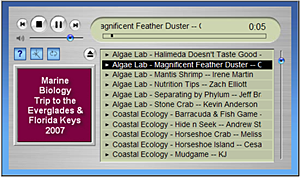
Click on the mp3 player to the left to hear over 150 sound files from the 2007 Florida Keys Trip.
|
The Bus Ride Down & Back
|
|
|
|
|
|
Parents worry and worry about the long bus ride to Florida -- but as you can see, students LOVE it because they're with ALL their friends for hours on end. What could be better? Besides, they really DO sleep on the overnight trip.
We leave Winston-Salem around 2 pm on a Saturday afternoon in 2 or 3 buses, depending on the number of students in the class. Dinner is at a rest stop along the Interstate. A fresh set of drivers is picked up close to Jacksonville, Florida for the remainder of our trip south. Around 6 am we roll into Homestead, Florida for breakfast before heading into the Everglades
|
|
|
|
|
|
Arriving at the Everglades early Sunday morning we stop at the Royal Palm Visitor's Center and hike out on the trails and boardwalks looking for alligators, anhingas, great white herons, and snapping turtles. Early spring is breading season so we often see nests of anhingas with fluffy white babies jostling for room in nests.
|
|
|
|
|
|
Sunday afternoon after leaving the Everglades and lunch in Homestead we head down the Keys highway towards Sea Camp on Big Pine Key. On Marathon Key we'll stop for about an hour to cool off in the water at Sombrero Beach.
|
|
|
|
|
|
Two or our labs at Sea Camp involve taking flattop boats out to the coral patch reefs. Everyone wears a Coast Guard approved snorkeling vest to help provide flotation. Mask, fins, and snorkel round out the equipment while we hunt for sergeant majors, barracuda, spiny lobsters, angel fish, and a myriad of other tropical fish species.
|
|
|
|
|
|
The shark pond is always a favorite with students! First we learn all about sharks, their habits, and their habitats. Then we don snorkeling gear (no flippers -- it stirs up the water), take a kick board to keep us on the surface, and launch out onto the waters of the shark pond in hopes that we will spot some of the sharks lurking on the bottom. (Actually, these are nurse sharks -- they don't eat 7th graders, only small crustaceans!)
|
|
|
|
|
|
This lab involves taking one of our buses north some five miles along the Florida Keys highway to Bahia Honda Key where a magnificent state park is located. Featured here are fossilized coral beds that form small tide pools. It's a totally different ecosystem than ones we will have seen at the coral patch reefs.
|
|
|
|
|
|
Each night at Sea Camp we have an additional lab. For this one we put on wading shoes, take flashlights and collecting buckets, and head out into the shallow low tide waters around Sea Camp to see what we can find. After collecting specimens for about an hour we head back to share our finds.
Plankton Lab
|
|
|
|
|
|
Another night lab at Sea Camp is called the Plankton Lab. Since it is at night and we're going out on the water, everyone must wear bright red Coast Guard regulation 'bricks' -- rigid styrofoam life vests. The boat moves slowly dragging a v-shaped net behind it with a bottle attached at the end. This bottle collects plankton, microscopic animals that form the basis of the ocean food chain. After "towing" fo plankton we take our bottle back to the lab and examine its contents under special stereoscopic microscopes.
|
|
|
|
|
|
"Cassiopeia" is really just the Latin name for the 'upside-down' jellyfish. First we wade across to Horseshoe Island to collect our specimens. Then, dividing into groups of two, we add stresses to the jellyfish environment and count the pulses (respiration) of the jellyfish. No, we don't harm them! After the lab we put the jellyfish back into their native shallow water environment.
|
|
|
|
|
|
The last stop on our Florida Keys trip is Sea World in Orlando, Florida. For safety reasons we stop here to allow our bus drivers significant down time before heading back to Winston-Salem. For students this is a chance to unwind, take a ride down splash mountain at Atlantis, go on the roller coaster, see some larger marine specimens like the endangered Florida manatee, catch the ever-popular Shamu show, and just plain relax and have a good time after a week of intensive science labs at Sea Camp
|
|
|
|
Testimonials
|
|
Comments from Students & Parents
|
|
April '08 Dates
|
|
4/26 - 5/02, 2008
|
|
Leave Saturday, April 26th at 2:30 pm and return by 7:00 am on Friday, May 2nd
|
|
FAQs
|
|
Frequently
Asked
Questions
|
|
Recent Trip Photos
|
|
8 Photo Galleries of the most recent Keys Trip
|
|
90+ Recorded Student Stories about the '05 Keys Trip
|
|
|
|
Florida Keys
Trip Resources
|
|
|
|
Scholarships
|
|
A Trip Scholarship Fund will be set up with one fund-raising activity scheduled before the trip. We can provide partial scholarships for up to 10 students since we typically raise about $2000. We encourage parents to ask students to contribute their own money towards the trip. Get creative with odd jobs, baby sitting, and chores. Our goal is to take ALL students who want to go on the trip.
|
|
Committees
|
|
Trip Receipts
# Parents Needed: 15
For each deposit deadline we need to write receipts, so that each student's payments are recorded and tracked. This is a requirement from the school system's accounting office. At the August meeting we'll put out a list of deposit dates and then ask parents to sign up in groups of 3 to help us keep track of writing receipts.
Poinsettia Sale -- Scholarship Fund-Raiser
(sell during Nov./ pick up on Dec. 5 -- 4-6 pm)
# Parents Needed: 10
Help unload the LA Reynolds delivery truck. Assist parents with orders & loading plants into cars 4 - 7 pm.
Trip Snacks (March/April)
# Parents Needed: 7
Put together non-carbonated drinks and snacks for kids during trip.
Trip Chaperones
(Sign up at August Keys Trip Info. Meeting)
For 2008:
Parents Needed: 5
(includes doctor)
Doctors Needed: 1
Telephone Tree
Will need 12-14 parents each willing to call a "group" of parents to let them know we have arrived safely. Need ONE parent to coordinate & get master group started.
|
|